Posts

Showing posts with the label themes

Should Wizard Hit Mommy? (Themes)
Image
Themes Storytelling and Control In “Should Wizard Hit Mommy?” the process of crafting a story is as important as the story itself. Indeed, Jack uses the Roger Skunk story to exercise control and decisiveness that he feels like he no longer possesses in his own life, and also to delay helping his pregnant wife, Clare, repaint the living room (and, in the process, delay confronting the fact that his family is about to get bigger). Far from merely a mechanism to get his daughter to sleep, the story becomes a way for Jack to re-contextualize his personal unhappiness, exercising total control over his simple narrative to compensate for a lack of control he feels in life. As a result, Jack is incredibly protective over his story and its hero, Roger Skunk, and views Jo’s attempts to change the structure of his story as more sinister attempts to control him as well. “Should Wizard Hit Mommy” was written in 1959 when John Updike was married to his first wife Mary Pennington. The couple lived in...
The Rattrap

Image
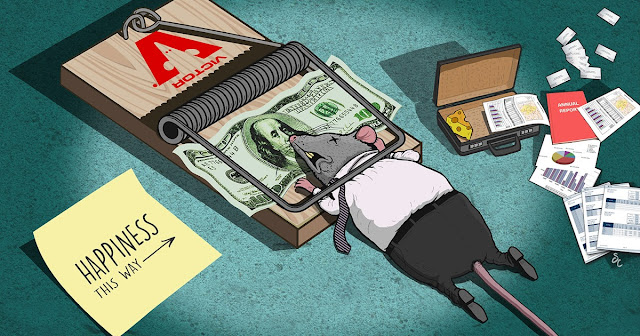
The Rattrap - Selma Lagerlof Characters   A tramp with rattraps. A crofter Master Smith in the Ramsjo Iron Mill in Sweden Helpers in the Mill – blacksmiths Iron mill owner Edla Willmansson – daughter of the Iron Mill owner. Justification of Title “The Rattrap” is an appropriate title as it is the story of a rattrap peddler. The author has used the metaphor of a Rattrap to highlight the human predicament. Just as a rat is fooled by the bait and gets trapped, most human beings also fall into the trap of material benefits. The story revolves around the incident of a man getting trapped due to his greed. Hence, the title is an apt one. THEME Human beings are prone to fall into the trap of material benefits. It is the human tendency to redeem oneself from dishonest ways. Hence, the whole world is called a big rattrap which tempts the people towards its materialistic benefits and brings about their doom and never-ending predicament. It also highlights the themes like human loneliness, st...

A Thing Of Beauty (Summary & Critical Analysis)

Image
‘A Thing of Beauty’, - A Critical Analysis The excerpt, A Thing of Beauty by John Keats, taken from a larger poem, 'Endymion: A Poetic Romance,' is written in the Romantic style of writing. 'A Thing of Beauty' romanticizes beauty as something that has the ability to transform lives. Romanticizing is about investing objects with larger than life attributes, it is about extolling the virtues of an object - it could be any object, the poet's beloved, nature, beauty (in the case of this extract) -  anything that has impacted the mind of the poet. Often, the poet might be compelled to write about an actual incident, like for example, in the poem, 'Daffodils', Wordsworth describes how one incident left a lasting impression on his mind. The sight of Daffodils dancing in the wind becomes a memory to fall back on when the poet, feels low at heart. Some of the important aspects of the poem are listed below: 1.Genre/Style of Writing: A Thing of Beauty belongs to the Ro...

A Thing Of Beauty (Intro & Theme)

Image
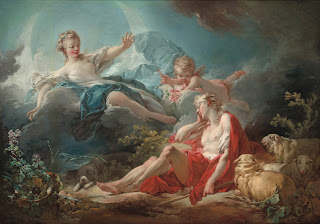
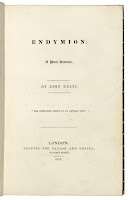
In Greek mythology – a vast component of Romantic-era education – the Aeolian shepherd Endymion, who resided in Olympia, attracted the attention of the Titan goddess Selene, of the moon. This youth makes a resolution to go after her and seek her. In this quest, he wanders through the forest and under the sea - So enamored was 'she' of the mortal that she asked Zeus to make him immortal so that he would never leave her as mortals did when they died. Zeus decides to grant her wish and puts him into an eternal sleep, which allows Selene to visit him every night. The subject of the story of Endymion has gone through a few variations over the years, but it was on this that John Keats based his 1818 poem, Endymion, which featured ‘A Thing of Beauty is a Joy Forever.' In the poem, the poet tells us that beautiful things bring immense pleasure and delight.  Furthermore, the poet explains that God's creations provide happiness as well as energy.  The things present all around pr...

The Third Level (Intro & Theme)

Image
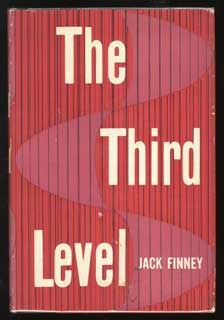
The Third Level by Jack Finney is about the harsh realities of war. War has irreversible consequences thus leaving people in a state of insecurity. It is also about modern-day problems and how the common man tends to escape reality by various means.  The narrator interweaves fantasy with reality in the most futuristic projection of time travel. Charley, a young New York commuter loses his way. he finds himself in what he thinks is the third level of the Grand Central Station in New York. The Grand Central Station has subways on two levels from where the commuters take trains to different destinations. No third level was ever built. However, Charley believes in the existence of a third level, operating in a time frame of the 1890s. The period of the 1890s represents a peaceful life not possible in the present era. From this level, Charley wants to travel to Galesburg, Illinois, with his wife Louisa. For him, it is a part of reality while his psychiatrist friend calls it a "waking-d...

An Elementary School Classroom in a Slum (Theme & Analysis)

Image
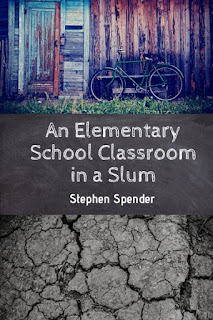
THEME : Social injustice and class inequalitie s  Main Points  Stanza-1  The poem portrays a picture of an elementary school in a slum area. Deprived of basic facilities such as-nutritional food, balanced diet, air, sunshine and potable water, children are least interested in studies The tall girl and paper seeming boy-all are victims of malnutrition; they are suffering from various diseases A boy sitting at the back is dreaming of squirrel's game. He has no interest in class-room activity. Stanza-2  The class-room wall contains pictures and paintings - like Shakespeare's head developed cities with skyscrapers Tyrolese valley aesthetically beautiful, problem free world(cloudless at dawn)-they came by donations. These pictures belong to the world of the rich and prosperous. The world of these poor and deprived children contrasts with the world depicted on classroom walls. The rich have drawn an open handed map which is of no use to them as their world is limited to th...

My Mother at Sixty Six (Central Theme)

Image
Central Theme The poem, ‘My Mother at Sixty-Six,’   is an intimate work presenting the poet’s thoughts. It deals with the feeling of fear and emotions that daughters experience with their mothers. Any child is attached to its mother. Similarly, children generally are afraid of losing their mothers. This poem brings out this ordinary but profound human nature through a personal reverie. Death is inevitable but people are afraid of losing their dear ones. As the poet expresses, the bond between a mother and her child is special; and therefore, the anxiety in losing the relationship is also strong. As its thematic concern, the poem brings out the inner thoughts of a daughter for her mother. Form, Style, and Literary Devices The poem, ‘My Mother at Sixty-Six,’ is confessional. As such, it is a first-person monologue. It runs like an aside. The poet expresses her inner thoughts and her reactions to those thoughts. The language is conversational. The arrangement of the lines is free and ...

The Enemy (Themes)

Image
THEMES Racism as a By-Product of Nationalism All of the Japanese characters exhibit a profoundly antagonistic attitude toward white people. The only explanation for this deep-seated hatred of whites and feeling of superiority toward them is offered through the experiences of Sadao in America. Yet, every one of his recollections proves to reference people who were kind, merciful or showing compassion toward him. If experience is the driving mechanism behind such comprehensive hatred and dismissal of millions of people simply due to the color of their skin, then Sadao’s racism can only be termed irrational. In this way, that racism is inextricably linked to the negative influence of nationalism. Since Sadao’s experiences do not align with his bias, it can only be explained as a condition engendered by a steady diet of nationalist propaganda. Duty vs. Self-Interest This theme is explored through two different men representing two distinct expressions of self-interest. Sadao knows it is hi...